
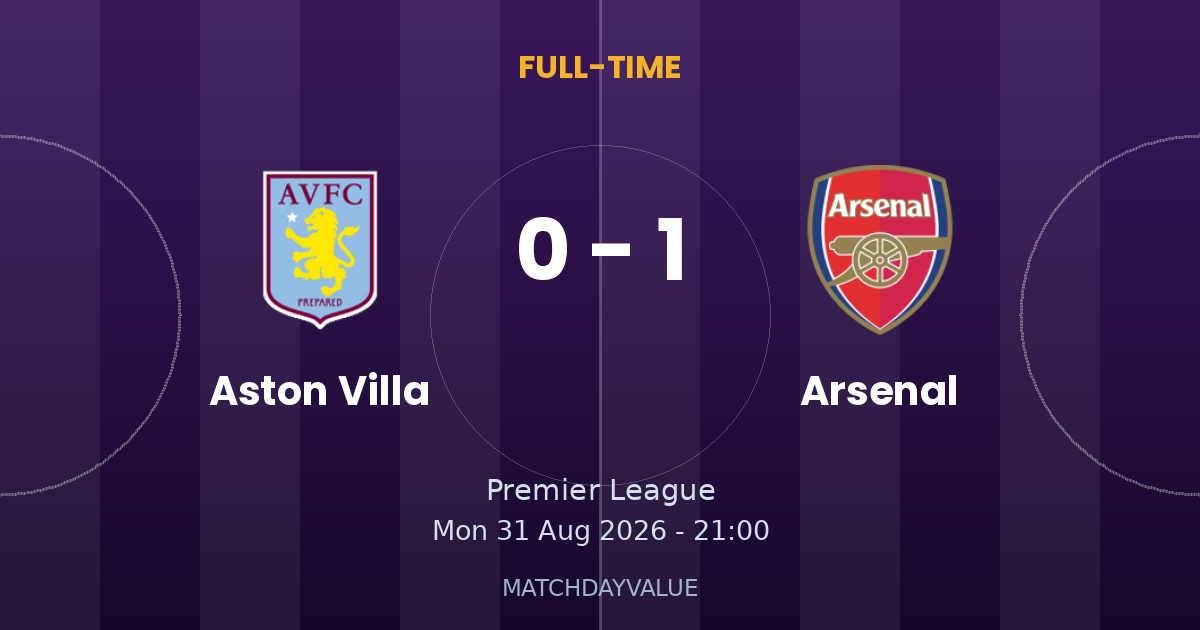
Arsenal Claim Vital Premier League Win at Villa Park as Saka Strike Proves the Difference
Premier League · Regular Season – 2
 Aston Villa
FULL-TIME
 Arsenal
Monday 31 August 2026 · 21:00 · Villa Park, Birmingham
Arsenal secured a hard-fought 1-0 victory at Villa Park in the Premier League, with Bukayo Saka’s second-half goal proving enough to separate two sides who rarely threatened to produce a high-scoring affair. The result is a significant three points for Arsenal, who controlled large portions of the contest without ever truly cutting loose, while Aston Villa were left frustrated by a toothless attacking display that will give their coaching staff plenty to reflect on.
How the Game Unfolded
The opening exchanges were relatively measured, though the first moment of controversy arrived on 29 minutes when Arsenal’s C. Tzolis was shown a yellow card for roughing, a booking that would ultimately cut short his involvement in the contest. Despite the caution, Arsenal maintained their composure and kept possession efficiently in the first half, though neither side managed to create the clear-cut chances the occasion perhaps demanded.
The half-time break brought an immediate change from Arsenal’s bench, with E. Eze introduced in place of the already-booked Tzolis at the start of the second period — a sensible, pre-emptive decision that allowed the visitors to refresh their attacking options before any further disciplinary risk could materialise.
The game’s decisive moment came on 59 minutes. Bukayo Saka converted what the data records as a normal goal, with the assist credited to R. Calafiori — a contribution that underlined Arsenal’s ability to build through their defensive line and find the killer ball in the final third when it mattered most. It was a moment of clinical efficiency from a side that had been patient and methodical throughout.
Arsenal moved to manage the game following the goal, making a triple substitution on 71 minutes as M. Odegaard and M. Lewis-Skelly were withdrawn, with M. Merino and Bruno Guimaraes among those introduced. Aston Villa responded with their own double change at the same point, bringing on N. Jackson and G. Hemmings in search of an equaliser, before further alterations on 78 minutes saw M. Cash and R. Barkley enter the fray. Arsenal’s final substitution saw D. Rice replaced by M. Zubimendi on 85 minutes.
Villa’s frustration boiled over in the closing stages. Alysson was cautioned for roughing on 80 minutes, J. McGinn followed with a yellow card for tripping on 81 minutes, and I. Maatsen received the hosts’ third booking deep into stoppage time for roughing — a disciplinary record that reflected a side struggling to make their mark through legitimate means. Arsenal’s final change, C. Mosquera for E. Konsa on 79 minutes, helped the visitors see out the result with relative comfort.
The Numbers
The statistics paint a clear picture of Arsenal’s dominance in this fixture. The visitors commanded 61% of ball possession compared to Villa’s 39%, completing 463 of 527 passes for an accuracy rate of 88%. Villa, by contrast, managed 272 accurate passes from 337 attempts, achieving 81% accuracy — respectable in isolation but a reflection of how much less of the ball they were given to work with.
Perhaps the most telling statistic of the afternoon was Villa’s shots on goal tally: zero. The hosts fired seven shots in total, with five missing the target and two blocked, but not a single attempt required their opponents’ goalkeeper to make a save. Arsenal, meanwhile, registered two shots on goal from their seven attempts, with five of their efforts coming from inside the box. Their expected goals figure of 1.05 compared to Villa’s 0.31 tells its own story — Arsenal were the more dangerous side throughout, even if the margin of victory remained slim.
Arsenal were also penalised far less frequently, committing just six fouls to Villa’s 16. The visitors did struggle with discipline in one particular area, however, racking up eight offsides — a figure that suggests their forward line was repeatedly caught in advanced positions before the ball arrived. Villa collected three yellow cards to Arsenal’s one, and Arsenal earned four corner kicks compared to Villa’s two.
Conclusion
This was a controlled, professional performance from Arsenal, who did not always dazzle but found the goal they needed through Saka and defended it with authority. For Aston Villa, a return of zero shots on target and an xG of just 0.31 summarises an afternoon in which they offered precious little going forward. Three points and a clean sheet will be the only numbers that matter to Arsenal’s camp as attention turns to the next fixture.

Writes match previews, predictions, and post-match analysis for MatchdayValue, covering the top five European leagues and Europe's continental competitions.
You might also like
Mainz 05 Demolish Hamburger SV 5-0 in Bundesliga Rout
Full-time: Hamburger SV 0-5 FSV Mainz 05. How the match unfolded, the key stats, and what the result means.
Inter Claim Dramatic Serie A Victory Over Napoli With Late Lautaro Strike
Full-time: Inter 3-2 Napoli. How the match unfolded, the key stats, and what the result means.

Real Betis Stun Real Madrid With Late Parrott Goal in La Liga Upset
Full-time: Real Betis 1-0 Real Madrid. How the match unfolded, the key stats, and what the result means.
Lille grind out crucial Ligue 1 victory at Toulouse with Ueda’s decisive strike
Full-time: Toulouse 0-1 Lille. How the match unfolded, the key stats, and what the result means.